

EU-STRAT is an international research project that studies the relationship between the European Union and the countries in the European Eastern neighbourhood. The project is financed by the Horizon 2020 program of the European Union. It started on 1 May 2016 and will continue until the end of April 2019. The main ambition of EU-STRAT is to provide an inside-out analysis and strategic assessment of the links between the EU and Eastern Partnership countries. EU-STRAT will address two main questions: First, why has the EU fallen short of creating peace, prosperity and stability in its Eastern neighbourhood? And second, what can be done to strengthen the EU's transformative power in supporting political and economic change in the six Eastern Partnership (EaP) countries? More information is available here.

I am also involved in an international project aiming to discover the conditions under which governments are responsive to public opinion. The project has support from a four-year Sapere Aude Grant from the Danish Council for Independent Research and a five-year VIDI grant from the Nederlands Organisation for Scientific Research. The principal investigator is Anne Rasmussen at the University of Copenhagen. Here is more info from the project's website: In democracies, a central concern is whether government policy is responsive to citizen preferences. GovLis aims at extending our existing knowledge of political responsiveness. It explores how a) interest groups, b) differences in the character of the debated policies/issues, and c) institutional differences between countries affect whether public opinion is translated into policy. For more information about GovLis, click here.


This research project investigated the interactions between the European Commission, the Member States and the European Court of Justice in enforcing EU law. The aim was to understand the strategic implications of the EU infringement procedures, and the broader intention was to contribute to a more general theory of dispute-resolution mechanisms in multi-level systems of governance. The project was supported by a VENI grant provided by the Dutch Organization for Scientific Research (NWO).

MAXCAP was a massive FP7-financed project involving academics from nine countries under the coordination of Leiden University and the Free University in Berlin with the general aim of studying the lessons and prospects for EU enlargement. My own contributions are related to examining European public attitudes towards past and future enlargements, and to investigating the impact of the Eastern enlargement on EU decision making. More about the MAXCAP project is available here.
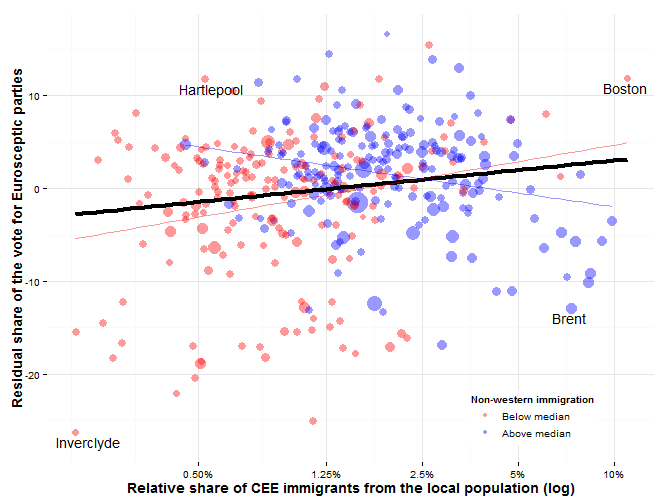
What is the impact of immigration on European integration? In particular, what has been the impact of migration from Central and Eastern Europe to 'old' Europe on public support for the European Union? The short answer is that immigration from CEE has eroded support for the EU among the European citizens of the recipient countries. Immigration undermines integration, yet immigration is necessary if integration is to succeed. We (with Elitsa Kortenska) show that this negative relationship holds in four West European states - The Netherlands, Spain, France, and Ireland. The published article presenting these findings is here. Currently, we are finalizing a paper which reports finding the same relationship in the context of the 2014 elections for the European Parliament: more CEE immigratns in a locality are related with higher shares of votes cast for Eurosceptic parties. A methodological offshoot of this project is a paper on multi-level modelling and post-stratification with Eurobarometer data.
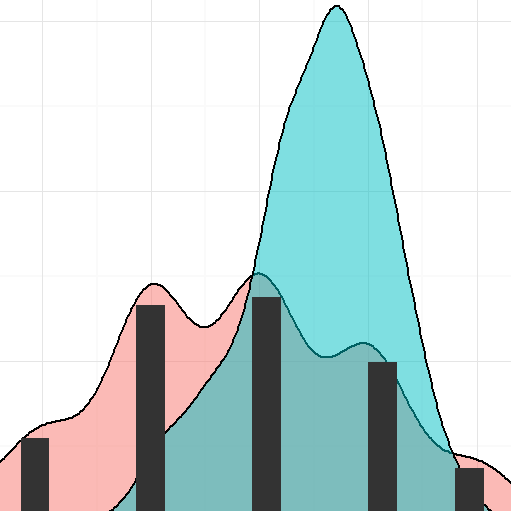
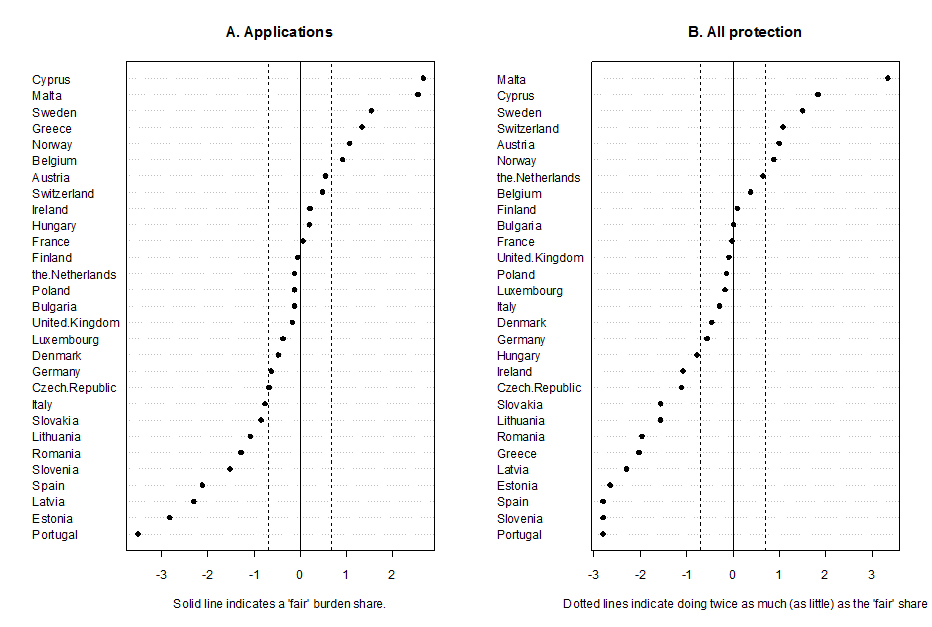
What influences the variation in asylum applications and recognition rates? Despite its obvious practical relevance, this question has not received a satisfactory answer in the academic literature. This paper focuses on the impact of the EU on asylum policy outcomes in 29 European states and argues that there has been no race to the bottom with respect to recognition rates and admitted refugees, but despite the relative convergence important national differences persist and the asylum burden has not become more equally-distributed across the European recipient countries. And this article argues that although asylum application shares and recognition rates are weakly though detectably linked, reducing recognition rates is likely to have a negligible impact on the asylum applications a country receives.
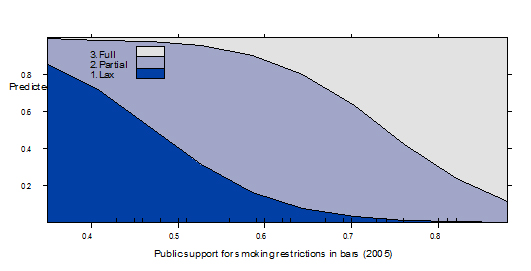
What explains the differences in the timing and strictness of anti-tobacco legislation adopted by the European states? Such questions of comparative public policy continue to fascinate me. In my first paper on the issue I argue that party ideological preferences cannot account for the pattern of adoptions of smoking bans (in bars and restaurants) in Europe, but public support for the measures, smoking prevalence, the economic importance of tobacco growing for a country, and policy diffusion are important factors affecting the timing of adoption and the strictness of the bans. I have also collected rich data on the course and determinants of Dutch anti-smoking policy which I use on my teaching and might one day lead to a publication.
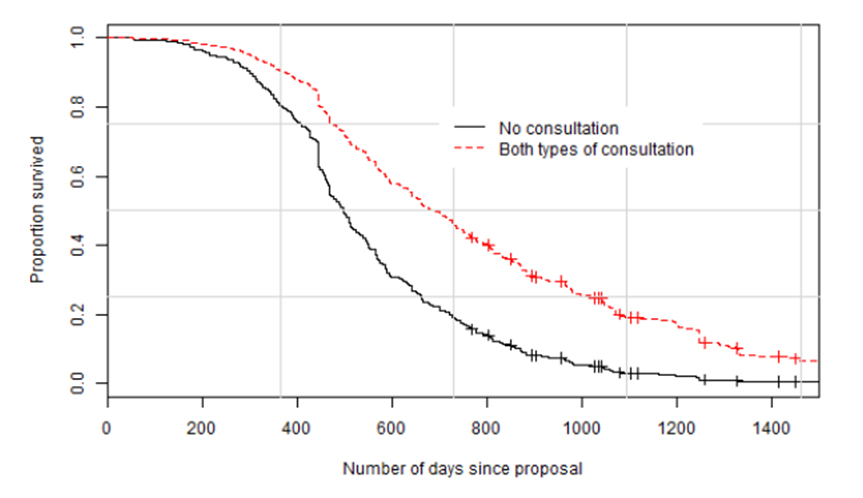
What are the determinants of the duration of legislative decision making? Together with my colleague Anne Rasmussen we tackle this question from a number of perspectives. This article argues that the European Parliament uses more time for deliberation under the co-decision versus the consultation procedure even after controlling for the character of the files. This article shows that the negotiation of legislation under the so-called co-decision 'early agreements' (trilogues) takes longer than that of similar files that go to second reading and conciliation, especially when really salient issues are at stake. In this paper we demonstrate that the involvement of interest groups during legislative preparation (and the diversity of the consulted groups) increases duration, while the type of consultation does not matter.
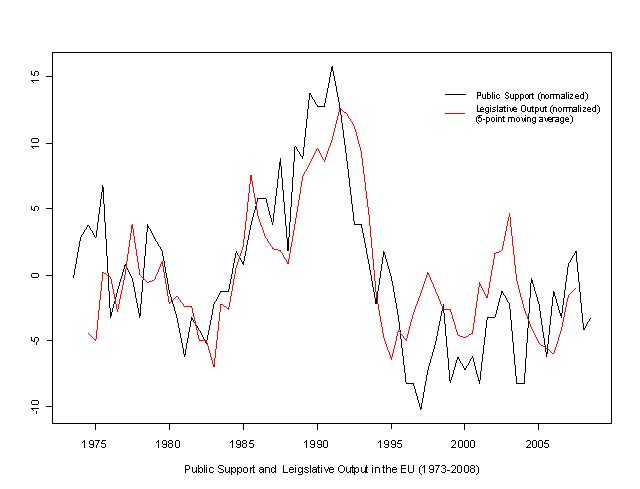
What are the dynamic relationships between public opinion, party preferences, interest groups, and the policy output of the EU? In this article I argue that the amount of important legislation that the EU produces follows the ebbs and flows of EU public support (but not vice versa) and that, surprisingly, the relationship holds up till the mid-1990s but disappears afterwards. Together with Frank Haege we show that the Commission proposes more legislation when it faces more EU-friendly governments in the Council of Ministers. In an article written together with a team of current and former colleagues at Leiden we investigate the dynamic links between interest group mobilization and legislative output and show that the timing of mobilization of interest groups in the EU is not related to the timing of legislative activity: interest groups neither lead nor lag bursts in European legislation.
The implementation of EU policy at the national level is exciting because the countries have much discretion in deciding when and how to implement the laws decided in Brussels.
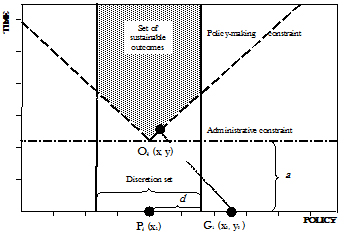
My PhD thesis examined the process of compliance with EU legislation in the Central and Eastern European countries during their accession negotiations. I developed a decision theoretical model which provides hypotheses about the impact of administrative and policy making capacities, policy preferences and discretion. This article shows that the CEE countries having higher bureaucratic quality and more right-wing governments have performed better in implementing EU directives. This article makes a similar argument for the particular case of social policy. Here, we (with Antoaneta Dimitrova) argue that the strength (but not the organizational type) of EU co-ordination units of the CEE governments influence positively compliance with EU law.
Analysing the implementation of EU directives in all 27 member states, we (with Bernard Steunenberg) demonstrate that legal fit and discretion are significant determinants of the timeliness of implementation. In this article (and this reply to the reply) I take issue with the argument that implementation patterns can be related to certain 'cultures of compliance'. Finally (for now), I have developed systematic reviews of the statistical and qualitative literatures on the topic (available online here and here), and my discussions of the state of the art of these literatures can be found here and here.
Why do governments change their organizational structures? Despite the myriads of organizational births, deaths, mergers, fusions and splits in the public sector, there is surprisingly little theory addressing the causes of government re-organizations, and even less so addressing their effects. In my MA thesis I argue that the pattern of government reorganizations in Bulgaria reveals that it is the desire of politicians to capture the organizations rather than concerns about efficiency that explains the constant cycles of organizational reforms in the country. In this article co-authored with Antoaneta Dimitrova, we look at the re-organizations of the EU co-ordination structures of the countries from Central and Eastern Europe and conclude that the organizational configurations reflect the power balance between the major political actors in a country and the changes have little to do with path dependency or efficiency concerns but follow power shifts after elections.